

The Rise of Generative AI and Why It Matters Now
Artificial intelligence has quietly reshaped industries for decades, but nothing has captured the collective imagination of businesses, creators, and technologists quite like generative AI. From drafting emails and writing code to producing photorealistic images and composing music, these systems have moved from research labs into the daily workflows of millions of people worldwide. Understanding what this technology is, how it works at a foundational level, and why it matters right now is no longer optional but essential for professionals navigating the modern landscape.
What Exactly Is Generative AI?
At its core, generative AI refers to a class of artificial intelligence models designed to create new content rather than simply analyze or classify existing data. Traditional AI might tell you whether an email is spam. Generative AI writes the email. It produces outputs like text, images, audio, video, or code that are original yet informed by patterns learned from vast datasets during training.
The most prominent examples today are large language models (LLMs), the technology behind tools like ChatGPT, Google’s Gemini, and Anthropic’s Claude. These models don’t just retrieve information; they generate coherent, contextually relevant responses by predicting the most likely next word (or token) in a sequence, drawing on billions of parameters refined through extensive training.
The Breakthrough That Changed Everything
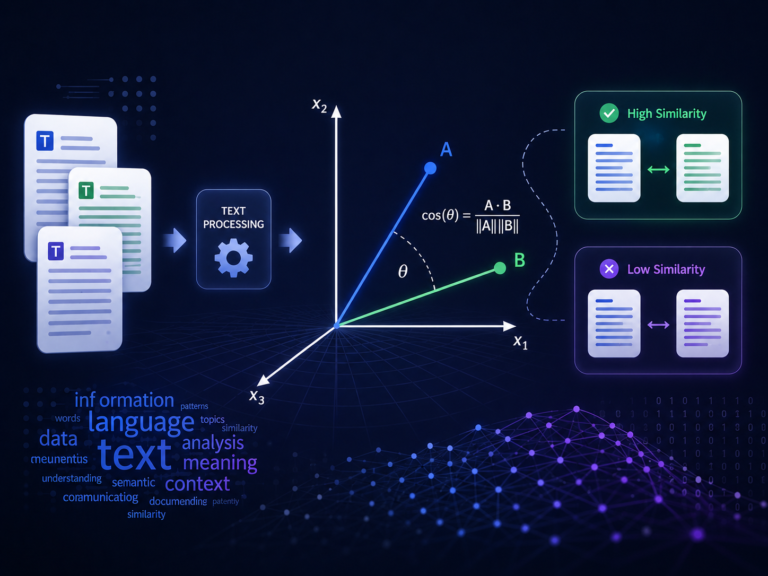
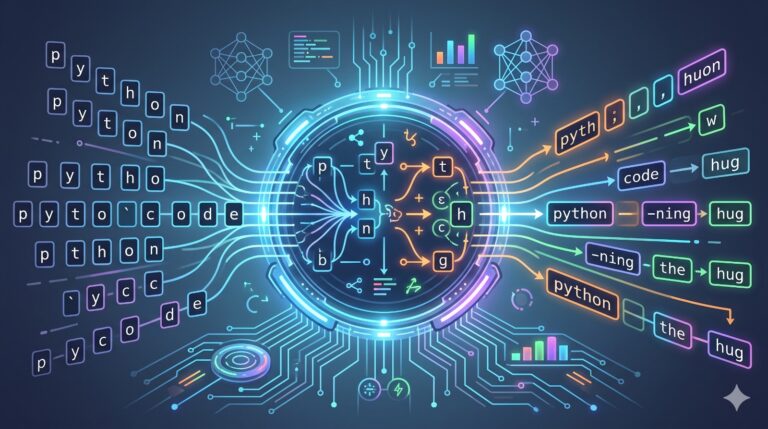
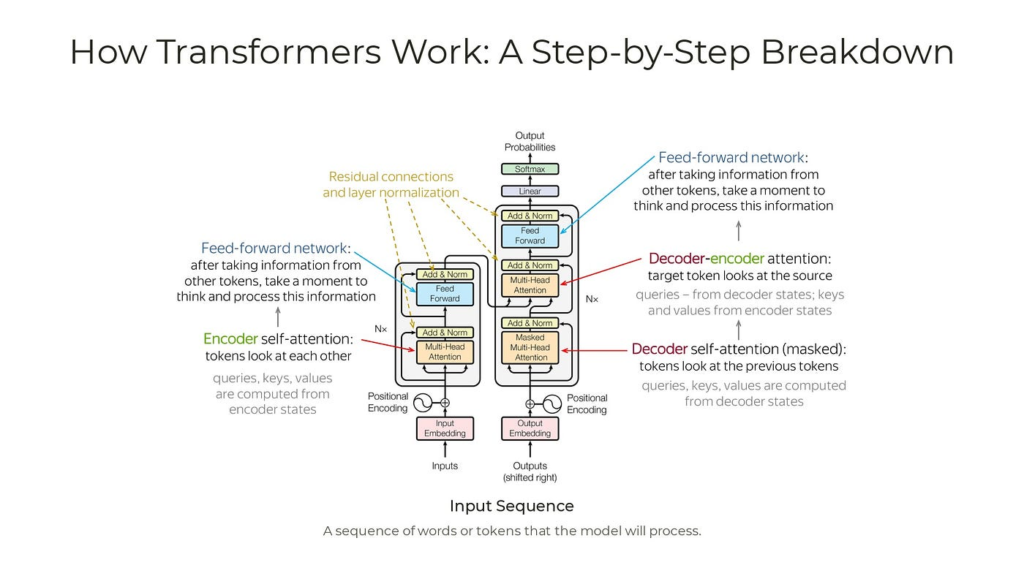
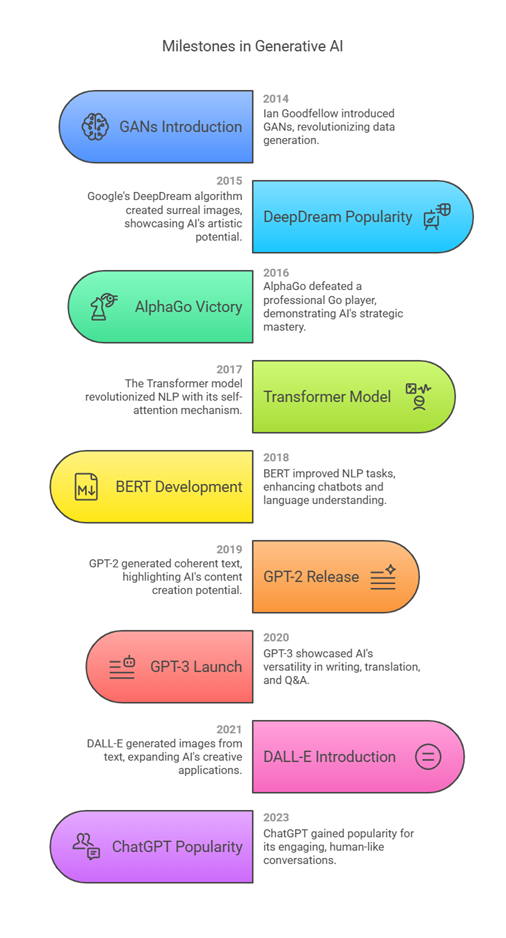
The story of modern generative AI begins in 2017, when researchers at Google introduced the transformer architecture which was a pivotal innovation that fundamentally changed how machines process language. Before transformers, AI models struggled to maintain context across long passages of text. The transformer solved this by encoding each word as a token and generating what’s known as an attention map, which captures the relationships between every token in a body of text. This mechanism allows the model to grasp nuance, context, and meaning at a scale previously unachievable.
This single architectural innovation unlocked the rapid development of increasingly powerful LLMs, each generation more capable than the last. It’s the reason we’ve witnessed an explosion of practical applications in just a few short years.
Why It Matters Now
Several converging factors make this moment uniquely significant:
- Accessibility: Generative AI tools are no longer confined to researchers. Platforms like ChatGPT and Claude have made powerful AI available to anyone with an internet connection.
- Enterprise adoption: Organizations across healthcare, finance, legal, and creative industries are integrating generative AI into core operations—from automating customer service to accelerating drug discovery.
- A maturing lifecycle: The generative AI lifecycle spanning data gathering, model selection, fine-tuning, performance evaluation, and deployment is becoming more standardized and repeatable, lowering the barrier to entry for businesses of all sizes.
- Economic impact: McKinsey estimates that generative AI could add up to $4.4 trillion annually to the global economy, transforming productivity across virtually every sector.
For decision-makers, this means generative AI isn’t a future consideration—it’s a present-day competitive advantage. For aspiring data scientists and technical professionals, understanding the fundamentals of LLMs, transformer architectures, and scaling laws provides a critical foundation for career growth.
Setting the Stage
Throughout this post, we’ll demystify generative AI without requiring you to write a single line of code. You’ll gain a clear understanding of how these systems work, what they can (and cannot) do, and how organizations are applying them in the real world. Whether you’re evaluating AI tools for your team, exploring a career pivot into data science, or simply trying to make sense of the headlines, this foundation will serve you well.
What Is Generative AI? Understanding the Core Concept Behind ChatGPT, Claude, and Beyond
Now that we’ve established why generative AI demands attention, let’s examine what it actually is and what makes it so remarkably capable.
The Transformer: The Engine Behind the Revolution
As we touched on in the introduction, the transformer architecture is the breakthrough that made today’s generative AI possible. Here’s a closer look at why it matters.
In a transformer model, each word in a body of text is encoded as a token, and the system generates an attention map: a mechanism that captures the relationships between every token in the input. This attention map allows the model to understand context with extraordinary nuance, recognizing not just what words mean individually but how they relate to one another across sentences and paragraphs.
Large language models like those powering ChatGPT and Claude are built on this architecture. They are trained on enormous datasets of books, articles, websites, codebases absorbing the statistical patterns of human language at a scale no individual could replicate. The result is a system that can generate coherent, contextually relevant text that often feels remarkably human.
What Can Generative AI Actually Do?
The practical capabilities of large language models extend far beyond casual conversation. Here are some of the primary use cases driving adoption across industries:
- Content creation: Drafting emails, blog posts, marketing copy, and reports
- Question answering: Providing detailed, contextual responses to complex queries
- Summarization: Condensing lengthy documents into concise overviews
- Code generation: Writing, debugging, and explaining software code
- Translation and localization: Converting text between languages with contextual accuracy
- Reasoning and analysis: Breaking down complicated topics into accessible explanations
These capabilities make generative AI a powerful tool for professionals across virtually every domain. From marketing teams streamlining content workflows to data scientists accelerating exploratory analysis.
Why It Matters for Decision-Makers
Understanding generative AI is no longer optional for leaders navigating today’s technology landscape. These systems are reshaping how organizations operate, communicate, and innovate. However, it is equally important to recognize their limitations. LLMs can produce plausible-sounding but factually incorrect outputs (often called “hallucinations“), and they require thoughtful governance to use safely and responsibly. Knowing what generative AI can and cannot do empowers you to make informed decisions about where and how to deploy it.
# ============================================================
# Simple OpenAI API Example
# ============================================================

from openai import OpenAI # The official OpenAI Python client library


# ── Step 1: Create the client ────────────────────────────────
# The OpenAI client automatically reads your API key from the
# OPENAI_API_KEY environment variable.
client = OpenAI()

# ── Step 2: Define your prompt ───────────────────────────────
# This is the message you want to send to the model.
user_prompt = "Explain what a neural network is in two sentences, suitable for a beginner."

# ── Step 3: Send the request ─────────────────────────────────
response = client.chat.completions.create(
    model="gpt-4o", # Choose the model you want to use
    messages=[
        {
            "role": "system", # Give the model context/instructions
            "content": "You are a helpful assistant who explains technical concepts clearly and simply."
        },
        {
            "role": "user", # The actual question or prompt
            "content": user_prompt
        }
    ],
    max_tokens=200, # Limit the length of the response
    temperature=0.7, # 0 = focused/deterministic, 1 = creative
)


# ── Step 4: Extract the reply ────────────────────────────────
# The response object contains metadata and a list of "choices".
# We grab the text content of the first (and usually only) choice.
reply = response.choices[0].message.content


# ── Step 5: Display the result ───────────────────────────────
print("=" * 50)
print("Prompt:")
print(f"  {user_prompt}")
print("=" * 50)
print("Response:")
print(f"  {reply}")
print("=" * 50)Generative AI represents a fundamental shift in the relationship between humans and machines. Rather than simply automating repetitive tasks, these systems act as creative collaborators augmenting human expertise with speed, scale, and versatility. As tools like ChatGPT and Gemini continue to evolve, the professionals who understand their foundations will be best positioned to harness their potential while navigating their risks with clarity and confidence.
With this conceptual foundation in place, let’s go deeper into the mechanics: how do these models actually learn, and what does the training process look like?
How Generative AI Works: From Transformers to Training on Trillions of Tokens
At the heart of every generative AI system lies a deceptively simple goal: predict what comes next. Whether it’s the next word in a sentence, the next pixel in an image, or the next note in a melody, generative AI models learn patterns from massive datasets and use those patterns to produce new, original content. But the journey from raw data to a system like ChatGPT involves a sophisticated pipeline of architecture, training, and fine-tuning that’s worth understanding at a high level.
How Transformers Process Language
We’ve established that the transformer architecture is the engine behind modern generative AI. Now let’s see how it works in practice.
A transformer encodes each word in a body of text as a token and then generates an attention map that captures the relationships between every token in the input. In practical terms, this means the model can understand that in the sentence “The bank by the river was eroding,” the word “bank” relates to “river” rather than to finance. This ability to grasp context at scale is what makes large language models so powerful and versatile.
Training on Trillions of Tokens
Architecture alone isn’t enough. To generate coherent, knowledgeable responses, a model must be trained on enormous volumes of data. Modern LLMs learn from datasets comprising trillions of tokens drawn from books, websites, academic papers, code repositories, and more. During training, the model repeatedly attempts to predict the next token in a sequence, adjusting its internal parameters each time it gets something wrong.
The scale involved is staggering. Training a frontier model can require:
- Thousands of specialized GPUs running in parallel for weeks or months
- Trillions of tokens of diverse, curated text data
- Billions of model parameters—the internal weights the model adjusts during learning
Empirical scaling laws have shown that increasing both the size of the model and the volume of training data tends to improve performance in predictable ways. This insight drives the ongoing race to build ever-larger models, though it also raises important questions about cost, energy consumption, and diminishing returns.
From Pre-Training to Fine-Tuning
The typical LLM lifecycle doesn’t end with pre-training. The process spans several stages: data gathering, model selection, pre-training, fine-tuning, performance evaluation, and deployment.
Fine-tuning is where a general-purpose model becomes genuinely useful. By training the model further on a smaller, task-specific dataset—say, medical records, legal documents, or customer support transcripts—teams can adapt it to particular use cases without starting from scratch. This is how one foundational model can power a medical diagnosis assistant, a contract review tool, and a creative writing coach.
You don’t need to build a transformer from scratch to make informed decisions about generative AI. But understanding that these systems learn statistical patterns from data—rather than “thinking” or “knowing”—helps set realistic expectations. It clarifies why models can produce impressive results in one context and confidently generate nonsense in another. The architecture enables capability; the data shapes quality; and fine-tuning determines relevance.
Grasping these fundamentals positions you to evaluate AI products critically, ask the right questions of technical teams, and identify where generative AI can deliver genuine value in your organization. With this understanding of how models are built and trained, let’s explore the key techniques that make different types of generative AI possible.
Key Models and Techniques: GANs, Large Language Models, and Reinforcement Learning from Human Feedback
Generative AI doesn’t rely on a single breakthrough. It draws power from a family of models and techniques that have evolved dramatically over the past decade. Understanding these core approaches will give you a solid foundation for evaluating the technology’s capabilities and limitations, whether you’re exploring it as a practitioner or as a business leader making strategic decisions.
Generative Adversarial Networks (GANs)
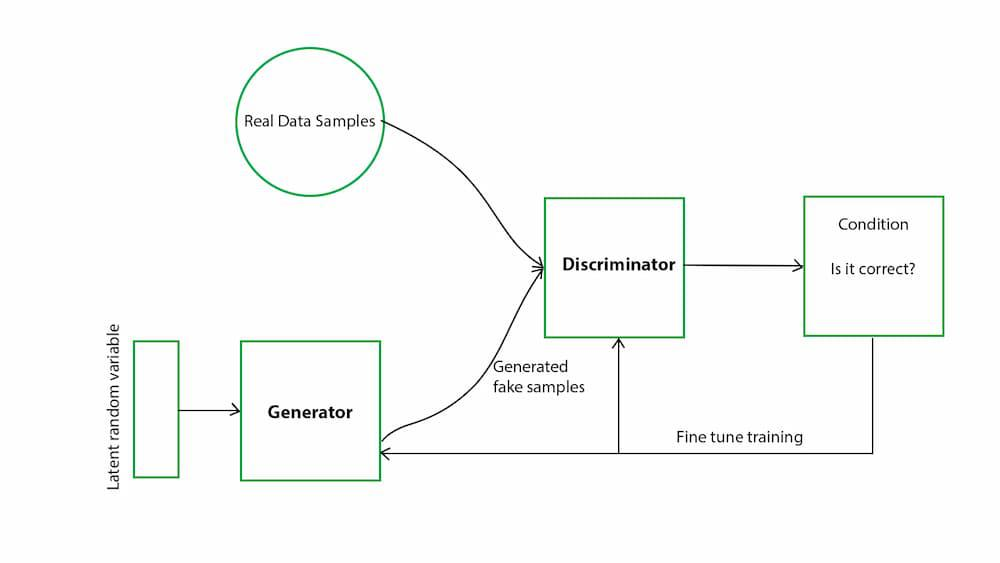
Generative Adversarial Networks, or GANs, were among the first architectures to capture widespread attention for their ability to create rather than simply classify. Introduced by Ian Goodfellow in 2014, GANs work through an elegant competitive mechanism: two neural networks: a generator and a discriminator that are pitted against each other. The generator creates synthetic data (such as images), while the discriminator tries to distinguish real data from fake. Over thousands of training iterations, both networks improve, and the generator eventually produces outputs that are remarkably realistic.
GANs remain widely used for tasks like:
- Image synthesis and enhancement (e.g., generating photorealistic faces, upscaling low-resolution images)
- Style transfer (e.g., converting photos into paintings in the style of a specific artist)
- Data augmentation for training other AI models when real-world data is scarce
While GANs excel at visual content, they can be notoriously difficult to train. They suffer from issues like mode collapse, where the generator produces only a narrow range of outputs. This limitation helped pave the way for newer architectures.
Large Language Models (LLMs)
Large Language Models represent the most transformative leap in generative AI. Built on the transformer architecture, LLMs learn the statistical patterns of language by training on massive text datasets. As research from the GPT family of models has demonstrated, scaling both model size and training data produces dramatic improvements in capability. The landmark paper “Language Models are Few-Shot Learners” (2020) showed that GPT-3 could perform a wide range of tasks—translation, summarization, code generation, question answering—specified purely through natural language prompts, with little or no task-specific training.
The typical LLM lifecycle involves several key steps: data gathering, model selection, fine-tuning, performance evaluation, and deployment. Organizations today can choose from foundation models like GPT-4, LLaMA, or Gemini and adapt them to specific use cases through fine-tuning—tailoring a general-purpose model to domain-specific needs without training from scratch.
Reinforcement Learning from Human Feedback (RLHF)
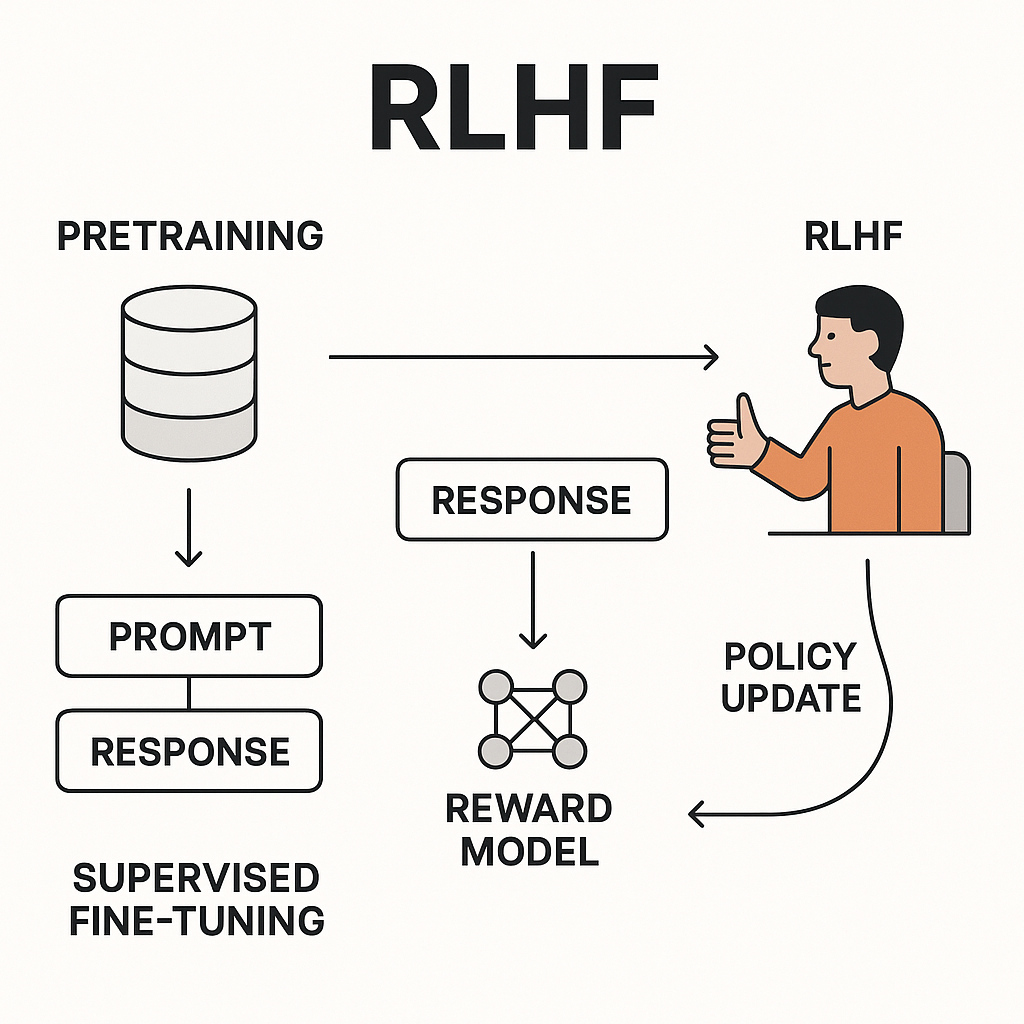
Raw language models are powerful but imperfect. They can generate text that is factually incorrect, biased, or misaligned with user intent. This is where Reinforcement Learning from Human Feedback (RLHF) enters the picture. RLHF bridges the gap between a model that can generate fluent text and one that generates text humans actually find helpful, honest, and harmless.
The process works in three stages:
- Supervised fine-tuning — Human reviewers provide example responses to prompts, teaching the model preferred behavior.
- Reward model training — A separate model learns to score outputs based on human preference rankings.
- Reinforcement learning optimization — The language model is further trained to maximize the reward model’s scores, effectively learning to produce responses that align with human expectations.
RLHF is the reason modern AI assistants like ChatGPT feel conversational and context-aware rather than robotic. It transforms a statistical text predictor into something that genuinely attempts to align with what users need.
Bringing It All Together
These three pillars—GANs for visual generation, LLMs for language understanding and creation, and RLHF for alignment—represent complementary pieces of the generative AI puzzle. In practice, modern systems often combine multiple techniques. Understanding how they work individually equips you to ask better questions, evaluate vendor claims more critically, and identify where generative AI can deliver genuine value.
So how are organizations actually putting these techniques to work? Let’s look at the real-world applications transforming industries today.
Real-World Applications: How Generative AI Is Transforming Industries
Generative AI is no longer a futuristic concept confined to research labs. It is actively reshaping how industries operate, how professionals work, and how organizations deliver value. From drafting lesson plans in education to generating production-ready code in software development, LLMs like those powering ChatGPT, Claude, and Google’s Gemini are driving a wave of practical transformation.
Education: Personalized Learning at Scale
In education, generative AI is enabling experiences that were previously impossible without one-on-one human tutoring. LLMs can generate customized quizzes, explain complex topics in multiple ways, and adapt their responses based on a learner’s level of understanding. Platforms like Khan Academy have already integrated AI assistants that guide students through problem-solving step by step, offering hints rather than answers.
For educators, the impact is equally significant. Teachers use generative AI to draft curricula, create differentiated learning materials, and generate rubrics for assessment—tasks that once consumed hours of preparation time.
Software Development: From Autocomplete to Co-Pilot
Perhaps no industry has felt the impact of generative AI more immediately than software development. Tools like Claude Code leverage LLMs trained on vast code repositories to suggest entire functions, debug errors, and translate natural language descriptions into working code. Developers report significant productivity gains not because AI replaces their expertise, but because it accelerates routine tasks and reduces context-switching.
The transformer architecture makes this possible. By encoding code as tokens and generating attention maps that capture relationships across a sequence, LLMs can understand context deeply—whether that context is a paragraph of English prose or a block of Python code.
Healthcare, Marketing, and Beyond
The applications extend well beyond education and software:
- Healthcare: Generative AI assists clinicians by summarizing patient records, drafting clinical notes, and suggesting differential diagnoses based on symptoms described in natural language.
- Marketing: Content teams use LLMs to generate ad copy, brainstorm campaign ideas, and personalize messaging across customer segments in minutes rather than days.
- Legal: Law firms deploy AI to review contracts, extract key clauses, and draft preliminary legal documents—dramatically reducing hours spent on routine analysis.
- Finance: Analysts leverage generative models to summarize earnings reports, generate risk assessments, and automate regulatory compliance documentation.
Each of these use cases follows a common pattern: organizations select a foundation model, fine-tune it on domain-specific data, evaluate its performance against defined benchmarks, and deploy it within controlled workflows.
Understanding these applications is not just relevant for engineers and data scientists. Non-technical leaders who grasp the capabilities and limitations of generative AI are better positioned to identify high-value use cases within their own organizations, allocate resources effectively, and set realistic expectations for AI-driven initiatives.
The key takeaway: generative AI is not a single product or tool. It is a capability layer powered by transformer-based LLMs that can be adapted, fine-tuned, and deployed across virtually any domain where language, data, or creative output plays a central role. The organizations thriving today are those that recognize this versatility and act on it strategically.
Of course, capability without caution is a recipe for trouble. Let’s turn to the limitations and risks that every professional should understand before deploying generative AI.
Limitations, Risks, and Ethical Considerations Everyone Should Know
Generative AI holds remarkable promise, but every powerful technology carries trade-offs. Before integrating these systems into your workflows or strategy, you need a clear-eyed understanding of where they fall short, where they introduce risk, and where they raise questions that no algorithm can answer on its own.
Hallucinations and Factual Reliability
Large language models work by predicting the most probable next token in a sequence, drawing on patterns learned from massive text corpora. The transformer architecture captures relationships between words through attention maps but it does not verify facts against a live database of truth. The result is a phenomenon known as hallucination: the model generates text that sounds authoritative and fluent yet contains fabricated statistics, invented citations, or subtly incorrect claims.
For decision-makers, this is not a minor inconvenience. Imagine a financial analyst using generative AI to draft a market brief that confidently cites a nonexistent regulatory filing, or a healthcare team relying on an AI-generated summary that misrepresents a drug interaction. The fluency of the output makes errors harder to catch, not easier.
Key takeaway: Always pair generative AI outputs with human review and, where possible, automated fact-checking pipelines.
Bias, Fairness, and Representation
Generative models learn from the data they are trained on. If that training corpus contains biases—racial, gender-based, cultural, or otherwise—the model will reproduce and sometimes amplify them. This matters in every domain: hiring tools that favor certain demographics, marketing copy that relies on stereotypes, or customer service bots that respond differently based on a user’s dialect.
Addressing bias requires deliberate effort at multiple stages of the AI lifecycle, from data gathering and curation to model evaluation and deployment. Understanding each step in this lifecycle equips teams to identify where bias enters and how to mitigate it through techniques like fine-tuning on balanced datasets and rigorous performance evaluation.
Data Privacy and Security
Generative AI systems often require large volumes of data for training and fine-tuning. This raises critical questions:
- Who owns the data used to train or prompt the model?
- Is sensitive information (customer records, proprietary code, personal health data) inadvertently exposed during interactions with AI tools?
- Can outputs be traced back to specific individuals in the training set?
Organizations must establish clear data governance policies before deploying generative AI at scale. Regulatory frameworks like GDPR and emerging AI-specific legislation add further urgency to getting this right.
Intellectual Property and Accountability
When a generative model produces content—a blog post, a piece of code, an image—who holds the copyright? What happens when AI-generated output closely mirrors someone else’s protected work? These questions remain legally unsettled in most jurisdictions. Decision-makers should work closely with legal counsel to understand exposure and establish usage guidelines.
The Human-in-the-Loop Imperative
None of these risks mean you should avoid generative AI. They mean you should deploy it thoughtfully. The most effective implementations keep humans in the loop: reviewing outputs, setting guardrails, and continuously monitoring performance against ethical benchmarks.
Think of generative AI as a powerful collaborator rather than an autonomous decision-maker. When you understand its limitations as clearly as its capabilities, you position your organization to harness its strengths while managing its risks responsibly. That balance between innovation and accountability is what separates strategic adoption from reckless experimentation.
With these guardrails in mind, let’s look ahead at where generative AI is going next.
The Future of Generative AI
The current landscape of generative AI, as impressive as it is, represents only the beginning. Understanding where the technology is heading requires a closer look at three critical dimensions: how these models scale, how organizations are adopting them, and what emerging trends will shape the next chapter.
Scaling: The Engine Behind Progress
What makes the transformer architecture so consequential is its ability to scale. Empirical scaling laws have shown that as researchers increase the size of training data, model parameters, and compute resources, LLM performance improves in predictable ways. This insight has driven an arms race among technology companies to build ever-larger models.
But scaling is not just about size. Fine-tuning enables organizations to adapt general-purpose LLMs to highly specific use cases—from medical diagnosis support to legal contract analysis—without training a model from scratch. This combination of scale and adaptability is what makes generative AI so versatile across industries.
Adoption Trends: From Experimentation to Integration
Across industries, generative AI adoption is accelerating. What began as experimentation with chatbots and text generators has evolved into strategic integration across core business functions. The typical LLM-based generative AI lifecycle that organizations now navigate includes:
- Data gathering and preparation — curating high-quality datasets relevant to the business domain
- Model selection — choosing between building custom models or leveraging pre-trained ones
- Fine-tuning and customization — adapting models to specific tasks and organizational needs
- Performance evaluation — rigorously testing outputs for accuracy, bias, and reliability
- Deployment and monitoring — integrating models into production systems with ongoing oversight
Non-technical decision-makers do not need to understand every architectural detail, but they do need to understand this lifecycle. It determines cost, timeline, and risk. Organizations that treat generative AI as a plug-and-play solution often struggle, while those that invest in a structured approach see measurable returns.
What Lies Ahead
Several trends will define the next phase of generative AI:
- Multimodal models—systems that process text, images, audio, and video simultaneously are expanding the range of practical applications far beyond text generation.
- Smaller, more efficient models are making generative AI accessible to organizations without massive compute budgets.
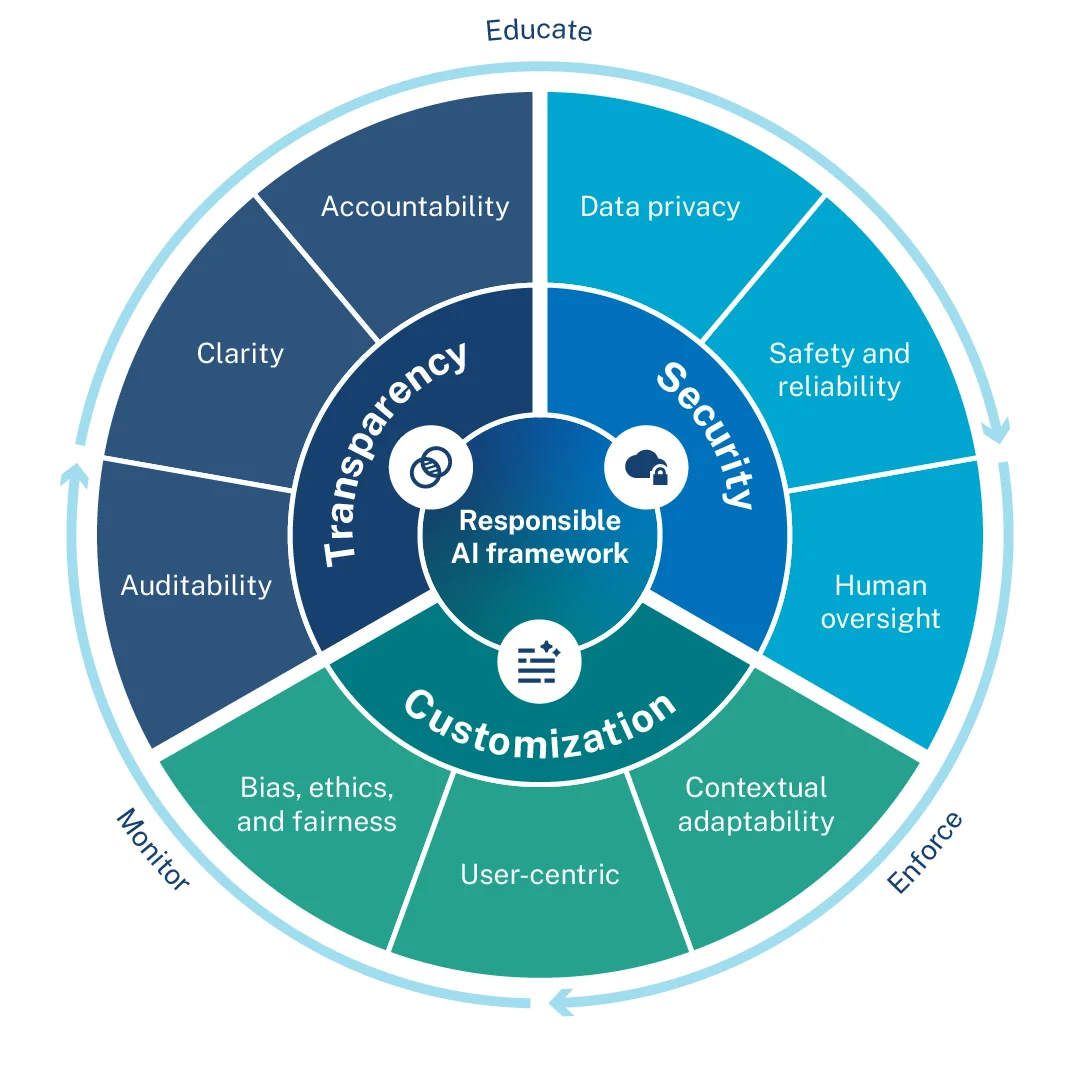
- Responsible AI practices are pushing the industry toward greater transparency, fairness, and accountability.
Perhaps most significantly, generative AI is becoming a collaborative tool rather than a replacement for human expertise. The core capabilities of LLMs—summarization, content generation, code assistance, translation, and reasoning—augment human decision-making rather than supplant it. Professionals who learn to work effectively alongside these systems will hold a distinct advantage.
The future of generative AI is not about a single breakthrough moment. It is about sustained, compounding progress—driven by better architectures, smarter scaling strategies, and thoughtful adoption. For professionals and decision-makers, the time to build foundational understanding is now, because the organizations that grasp these fundamentals today will lead their industries tomorrow.
Embracing Generative AI Responsibly in Your Career and Organization
As we’ve explored throughout this post, generative AI—powered by transformer architectures and large language models—represents one of the most significant technological shifts of our time. From the introduction of the transformer in 2017 to today’s sophisticated systems like ChatGPT and Claude, the pace of innovation has been remarkable. But understanding the technology is only the first step. The real question is: what will you do with this knowledge?
Moving from Understanding to Action
Whether you’re an aspiring data scientist, a business leader evaluating AI solutions, or a professional trying to stay relevant in a rapidly changing landscape, the fundamentals we’ve covered give you a critical foundation. You now understand that large language models work by encoding text as tokens and generating attention maps that capture relationships between those tokens enabling the model to understand context and produce coherent, human-like outputs. This isn’t magic. It’s mathematics, data, and engineering working in concert.
That foundation empowers you to ask better questions, make more informed decisions, and separate genuine capability from hype. In a field moving this fast, that discernment is invaluable.
Responsibility as a Guiding Principle
Embracing generative AI doesn’t mean adopting it uncritically. Responsible use requires attention to several key areas:
- Bias and fairness: LLMs learn from vast text corpora, which means they can absorb and reproduce societal biases. Organizations must audit outputs and implement safeguards.
- Transparency: Decision-makers should understand, at least at a high level, how their AI systems generate results. The full lifecycle, from data gathering through deployment, should be documented and reviewable.
- Data privacy: Generative AI systems often require significant amounts of data. Ensuring compliance with privacy regulations and ethical data practices is non-negotiable.
- Human oversight: AI should augment human judgment, not replace it entirely. Keeping humans in the loop, especially for high-stakes decisions, remains essential.
Your Next Step Matters
Generative AI will reshape industries, redefine roles, and create opportunities that don’t yet exist. The professionals and organizations that thrive will be those who engage with the technology proactively—learning its strengths, acknowledging its limitations, and deploying it with intention.
You don’t need to become a machine learning engineer overnight. But you do need to stay informed, stay curious, and stay deliberate. Start with one course. Experiment with one tool. Ask one new question about how generative AI could improve a workflow in your organization. Small, consistent steps compound into transformative expertise.
Frequently Asked Questions
Q: What is generative AI and how does it differ from traditional AI?
A: Generative AI is a class of artificial intelligence models designed to create new content—such as text, images, audio, and video—rather than simply analyzing or classifying existing data. Traditional AI focuses on tasks like detection and categorization, while generative AI produces original outputs using deep learning techniques like transformer models and GANs.
Q: What are some real-world applications of generative AI?
A: Generative AI is used across industries for content creation, code generation, image synthesis, music composition, drug discovery, and customer service automation. Popular tools like ChatGPT, Gemini, and Claude demonstrate how generative AI can assist with writing, design, and creative workflows at scale.
Q: How do large language models like ChatGPT work?
A: Large language models (LLMs) like ChatGPT are built on transformer architectures trained on massive datasets of text. They learn patterns in language to predict and generate coherent, contextually relevant text. Through techniques like pre-training and fine-tuning, these models can perform a wide range of tasks, from answering questions to writing code.
Q: What is the difference between GANs and transformer models?
A: GANs (Generative Adversarial Networks) use two competing neural networks—a generator and a discriminator—to produce realistic outputs like images and video. Transformer models use self-attention mechanisms to process sequential data and excel at text generation tasks. Both are foundational architectures in generative AI but serve different use cases.
Q: Why does generative AI matter for businesses and professionals right now?
A: Generative AI is transforming how businesses operate by automating content creation, accelerating product development, and enhancing decision-making. Professionals who understand this technology can leverage it to boost productivity, drive innovation, and maintain a competitive edge in an increasingly AI-driven marketplace.